

“Thoughts without content are empty, intuitions without concepts are blind.”
Immanuel Kant, Critique of Pure Reason
I have known Peter Thiel as a colleague, friend, and intellectual sparring partner for almost twenty-five years. Peter is not just one of the leading investors or entrepreneurs, but thinkers of our time. Over the last year, he has given a series of interviews and private lectures (some at our University of Austin) on the subject of the Biblical Antichrist, and possible existential threats to (and defenders of) our world.
If it were a random person — or even the average VC — deciding to wade into a subject like this, one could be forgiven for looking away from something that sounds wacky in our modern culture. But consider the source.
This is the person who made the first investment into Facebook, and wrote the first check from Silicon Valley to Donald Trump. In those two bets alone, Peter demonstrated an uncanny ability to focus on important ideas and people that will shape our civilization before others. Not to mention: he founded PayPal and led its team of future legends; together we co-founded Palantir; he was a very early (and key) backer of SpaceX at a time when no private space venture had ever succeeded. He predicted the hollowing-out of American universities. And he was a backer of JD Vance well before our now Vice President entered politics.
Given this record, when Peter focuses this much on something, one should keep an open mind. For me, as a student of history and philosophy like Peter, drawing on concepts and models from the texts that form the basis of our civilization is powerful way to access and think about complex topics, such as how a history-ending equivalent of the Antichrist might manifest as a one-world state of total “safety.”
Immanuel Kant, in his Critique of Pure Reason, explains the importance of unifying our intuitions with models and concepts. For Kant, we actually cannot think without them.
“Intuition and concepts … constitute the elements of all our cognition, so that neither concepts without intuition corresponding to them in some way nor intuition without concepts can yield a cognition. Thoughts without content are empty, intuitions without concepts are blind. It is, therefore, just as necessary to make the mind’s concepts sensible—that is, to add an object to them in intuition—as to make our intuitions understandable—that is, to bring them under concepts. These two powers, or capacities, cannot exchange their functions. The understanding can intuit nothing, the senses can think nothing. Only from their unification can cognition arise.”
Kant is a bit dense to some (okay, to me too usually), but think of it this way: if you want to build intuition for how to play a complex game, you have to form a hypothesis about how a good strategy might work, with a simple model in your head. Any guess is better than none. Then, play. Our minds evolved to iterate on conceptual models: you start with a model that’s wrong in various ways, and build intuition, improving it over time. Similarly, if you want to think and discuss hard concepts intelligently and come to new conclusions about not just games but business, investing, or even more abstract topics like how a threat analogous to the “Antichrist” might be generated or restrained, you have to build intuition by starting somewhere with relevant concepts.
For most people, going all the way back to some of the toughest Biblical texts like the Book of Daniel and the Book of Revelation and an idea like the Antichrist is just too difficult. And in an increasingly secular society, that makes Peter’s intellectual confidence to “go there” all the more worthy of our attention — whether you are secular or religious; a Jew, a Christian, or neither.
“The default political solution people have for all these existential risks is one-world governance,” Peter told the New York Times’ Ross Douthat, giving us a strong clue why he might have come up with these Antichrist lectures. Those risks might be AI, climate change, pandemics, nukes, or something else. In Peter’s telling, “The way the Antichrist would take over the world is you talk about Armageddon nonstop. You talk about existential risk nonstop, and this is what you need to regulate.”
In Christian thought, the only throne for the whole earth is that of Christ; and for us Jews, it is the covenants with God that were made so many generations ago. The Hebrew prophets and the authors of the New Testament—whose wisdom is the rock of our whole civilization—took the concept of Earth-consuming empires very, very seriously as violations of divine order, insofar as they try to substitute for either Christ or the Covenants. Genghis Khan, Alexander the Great, Adolf Hitler, and others wanted physical thrones over the earth. But it’s a fear that goes back much further, to the biblical texts from which the idea of an Antichrist arises.
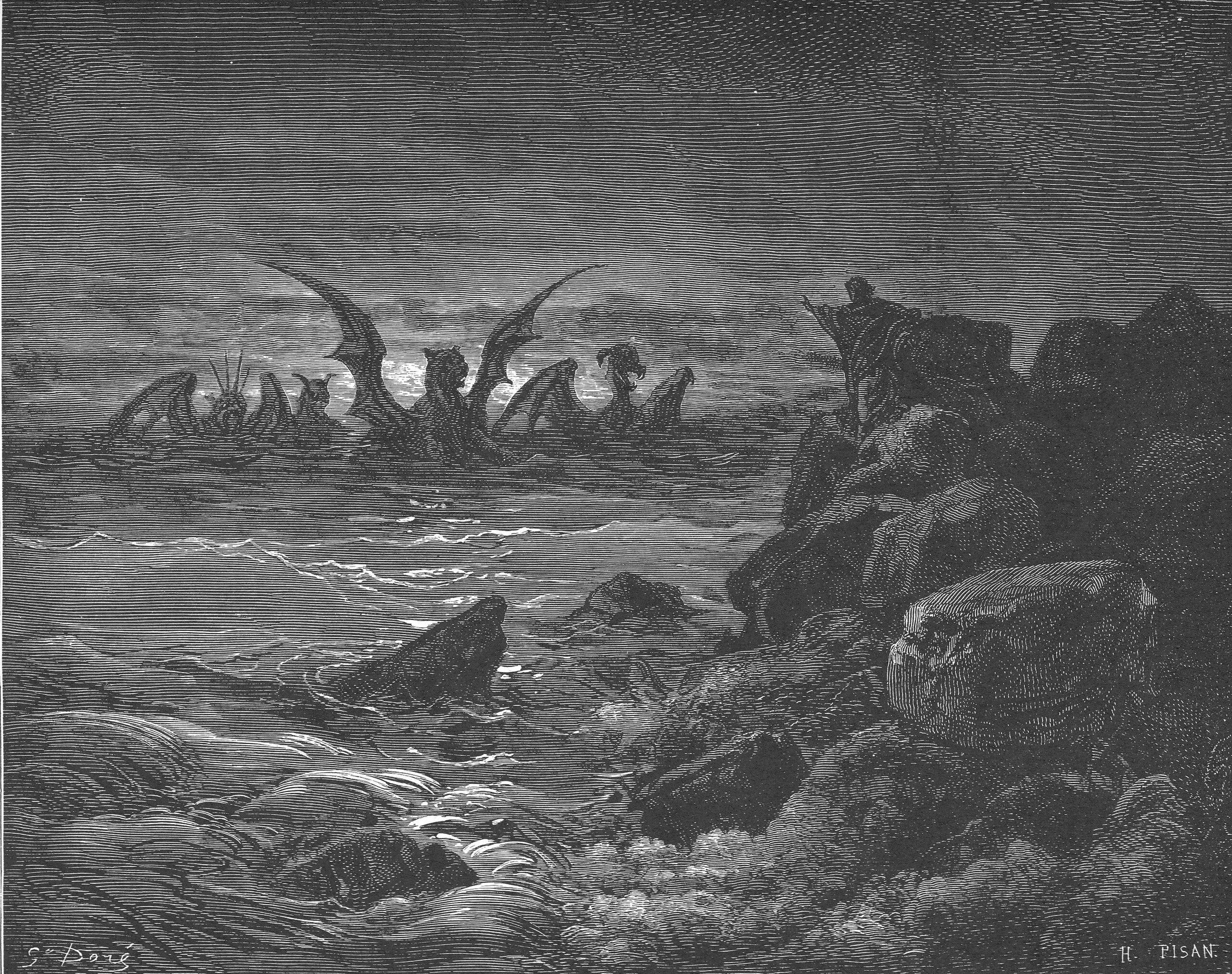
In the Babylonian Captivity, the Jewish exile Daniel had a series of terrifying, apocalyptic dreams of four beasts that precede the end of times. These dreams are recounted in the Book of Daniel in the ketuvim (‘writings’), the final section of the Hebrew Bible. Medieval Jewish thinkers thought the four beasts might be allusions to Nebuchadnezzar, who besieged Jerusalem and under whom the Jews were captive in Babylon; Belshazzar, the last leader of that dynasty; Alexander the Great; and the Roman Empire. It is in this book that the idea of the beast as a one-world state originates. In the the final verses of Daniel 7, God speaks to Daniel about a beast (kingdom) that would “devour the whole earth” and then be conquered:
‘The fourth beast shall be
A fourth kingdom on earth,
Which shall be different from all other kingdoms,
And shall devour the whole earth,
Trample it and break it in pieces.
The ten horns are ten kings
Who shall arise from this kingdom.
And another shall rise after them;
He shall be different from the first ones,
And shall subdue three kings.
He shall speak pompous words against the Most High,
Shall persecute the saints of the Most High,
And shall intend to change times and law.
Then the saints shall be given into his hand
For a time and times and half a time.‘But the court shall be seated,
And they shall take away his dominion,
To consume and destroy it forever.
Then the kingdom and dominion,
And the greatness of the kingdoms under the whole heaven,
Shall be given to the people, the saints of the Most High.
His kingdom is an everlasting kingdom,
And all dominions shall serve and obey Him.’
The Book of Revelation, the last book of the New Testament, had similar apocalyptic visions:
“And the whole earth was amazed and followed after the beast; they worshiped the dragon because he gave his authority to the beast; and they worshiped the beast, saying, ‘Who is like the beast, and who is able to wage war with him?’ A mouth was given to him speaking arrogant words and blasphemies, and authority to act for forty-two months was given to him. And he opened his mouth in blasphemies against God, to blaspheme His name and His tabernacle, that is, those who dwell in heaven.”
The word Antichrist (Ἀντίχριστος) means in place of, opposed to, or against the anointed one (Christ, χριστος). Katechon (κατέχον) is “that which withholds” or “the restrainer.” Both appear in the Apostle Paul’s Second Epistle to the Thessalonians. You will immediately recognize the similarity of Paul’s description of the “man of sin” to Daniel’s description of the evil king.
Now, brethren, concerning the coming of our Lord Jesus Christ and our gathering together to Him, we ask you, not to be soon shaken in mind or troubled, either by spirit or by word or by letter, as if from us, as though the day of Christ had come. Let no one deceive you by any means; for that Day will not come unless the falling away comes first, and the man of sin is revealed, the son of perdition, who opposes and exalts himself above all that is called God or that is worshiped, so that he sits as God in the temple of God, showing himself that he is God.
Do you not remember that when I was still with you I told you these things? And now you know what is restraining, that he may be revealed in his own time. For the mystery of lawlessness is already at work; onlyHe who now restrains will do so until He is taken out of the way. And then the lawless one will be revealed, whom the Lord will consume with the breath of His mouth and destroy with the brightness of His coming.
The scripture provides the basis for how people have understood concepts like the Antichrist. But one need not believe that a beast with ten horns and seven heads will physically arise from the sea, or even that the Antichrist is a single person. Christian thinkers have long debated these images. Peter leaves it up in the air what he believes. But contrary to the mockery from South Park or anyone else, Peter is not actually indulging apocalyptic fantasy, or weirdly obsessed with something irrelevant here. He is using his wisdom and wisdom from the ancients to help leaders build intuition about the biggest threats we face, and the dangers in how we confront them.
We must take freedom seriously without falling into the trap of believing we can protect freedom only by surrendering it to a global sovereign. One of Peter’s deepest and most unsettling points is that a katechontic bulwark—perhaps the one you and I still call “the last, best hope on Earth,” the United States of America—can itself become the Antichrist if it evolves into a homogenized world order. History is littered with empires that began as defenders of pluralism and ended as devourers of the earth.
The katechontic task is to confront those dangers head-on while simultaneously restraining the seductive argument that only a single planetary regime can save us. Indeed, a katechon itself — safetyism “saving” us from AI, or a one-world government “saving” us from war or climate change — can morph into an Antichrist if we are not careful.
Peter makes a lot of other points that it’s not my intention to cover here; and to be clear this is my take on his lectures, not his! It’s unclear to me if our culture is transcending or falling back past the age of the Enlightenment, as he also seems to hint, and if old superstitions, mimetic mobs, and other human instincts will play a bigger role in our society in the coming decades; but there is certainly wisdom in building intuition for what this could mean.
As a Jewish American, one of the most important aspects of our reality that I’ve come to understand today is how the reaction to Nazism and nationalism itself have shaped the last 80 years. On the one hand, it was absolutely necessary to do what the United States and our Allies did. But in reacting in horror at nationalism and embracing extreme forms of globalism after the war, some of our leaders and especially European leaders have created havoc in their countries. The reaction to their excessive globalism today is once again nationalism — some of which is clearly needed against the evils of extreme globalism, but which at the other extreme could threaten to echo the evils of the 1930s.
It would be impossible to go into detail on all these subjects, but what makes the models so useful is in testing our theories of present and future reality.
And as for Peter: giving us some of these models is the type of serious intellectual work that in previous ages would have been done behind the cloisters of universities and monasteries. And in doing that, Peter should earn immense credit. If you’re a leader interested in the future of humanity, I’d pay closer attention. Oh, and don’t immanentize the Katechon!
Joe, with all due respect to both you and Peter: Mr. Thiel's reflections on the Antichrist are reflections shared with select by-invite only audiences that have not been exposed to public scrutiny much less divinity scholarship. The functional equivalent of holding mass within a cathedral of invited elites. As far as many of us can tell from the coverage provided by curated version as told by the New York Times and transmissions that have been shared on social media, Mr. Thiel argues that those that seek to constrain the development of AGI and Super Intelligence might be representations of the antichrist. How quaint. This told by the first investor into Facebook the company that birthed the modern era of at-scale social media which can be thought of as phase 1 experimentation with algorithmic driven manipulation of our lived experiences. And look where that got us. Rising suicide rates, polarized society, I could go on. Now let's consider Peter's relationship to Sam Altman. So we are all supposed to believe that asking for guardrails and accountability on AGI that is hurtling towards (with a distinct meaning nonzero possibility) of societal collapse or rogue / non-human control, built and led by the same people who brought us to where we are as a society on the social media business model, that no one elected, aggregating the wealth of nations under a future promise of UBI and a plan to redistribute that wealth is unholy and will damn us to hell? What about us facing hell on earth which i would define as a future of violence, upheaval, fear, and destruction (as told by Revelations.) Finally: AGI itself definitionally fits squarely into the creation of a false god as warned by the book of Revelation. The language used by what I would call the 6 or so "horsemen" leading the AGI charge at times refer to AGI in pseudo religious terms. I think it is a fair enough ask to request that you, as Mr. Thiels' friend and business partner ask him to more broadly share his observations with the rest of us. I am not a hater of AGI or Technology, nor a luddite. As a career Navy SEAL i witnessed and lived within and operated across hellscapes...hell on earth. Ungoverned spaces where human life is valued at $0. I know what this place looks, feels, and smells like. It is always and everywhere typified by unengaged people who have no resources and no hope. They feel helpless, scared, and afraid. I don't want that outcome for my children, for America, for the Chinese, for anyone. Peter should deliver his thoughts to more than just a select few, in my opinion. With deep respect and sincerity: Sam Havelock, CEO of SOFX Media.
So because he made the first investment into Facebook we should take his predictions on the end of the world seriously? I think that might be peak ‘im a wealthy founder therefore I know everything’ syndrome