


Dear Reader,
Construction permitting is one of those policy areas that always sounds a bit esoteric. Who could get passionate about permitting reform? Let me try to persuade you with a single, big-picture sentence:
At the same time that the technological edge of our civilization is moving faster than ever toward great achievements, physical construction for everything from apartments to major industrial infrastructure is embarrassingly, catastrophically slow.
Today, it’s clear that permitting is an area where there is a large and widening gap (thanks to technology) between how the world works, and how it could work, with huge consequences for all of us. Upending the permitting regimes around the US is a lay-up if we care about building and achieving great things. My friend and erstwhile colleague Judge Glock and I have written a short blog about how to make the right changes. Enjoy!
Joe
The Case for Private Permitting
The private sector moves faster than the government at almost every conceivable task. With the growth of artificial intelligence, that divergence will widen.
Government’s lethargy means it will become an ever-tighter bottleneck for new projects, but most importantly for new construction. There is a solution: the government should allow private companies to provide inspections and permits for projects. These companies can use artificial intelligence and new technologies to make the permitting system both seamless and transparent. States that care about growth and affordability can expand existing third-party permitting opportunities, which have been used in many places for decades now.
In most of the country, building officials employed by local governments inspect and approve all new construction or rehabilitation. These officials generally are not required to have any education or background in construction, and the government makes itself immune to lawsuits from any failures of these officials.
Government permitting has long been a realm of both arbitrariness and corruption. In fact, it is the very slowness of the process that allows officials to demand cash to move it along. Just this year, a plan-checker for San Francisco’s building department was sentenced to prison for accepted tens of thousands of dollars in bribes to approve and expedite permits, a California town inspector was charged with soliciting a bribe to accelerate a building plan that had stalled a construction project, a supervisor at the New York City Department of Buildings was indicted on accepting tens of thousands in bribes to accelerate permits, and two Suffolk County, New York building officials were indicted on bribery to accelerate permits.
In some places fraud can become the norm. A decade ago, New York City indicted 16 city officials for accepting or demanding bribes to facilitate inspections or permits. The more complicated and convoluted the process, as in New York, the more opportunities for officials to demand payment to clear them away.
For years, however, many areas with insufficient public funds or small local inspection departments have outsourced inspections and permitting to the private sector. In these cases, the government either has a list of pre-approved firms to provide services (say, several firms for fire code inspection, several firms for plan review, etc.) or sets standards for any firm that wants to provide those services.
In the third-party or private sector model, the government’s job is pushed one step back: from performing the actual inspections to keeping tabs and supervising the inspectors and plan approvers. It creates a clear framework for approval and disapproval and allows others to figure out how to meet that. The private firms’ decisions are considered approved unless the government has a clear and articulable reason they are wrong.
Private firms that know how to use technology for inspections and permitting will have a substantial advantage over building code officials with no background in either engineering or AI. Private companies today are already using thermal imaging, infrared cameras, satellites, drones, and other tools to perform Remote Virtual Inspections. These tools are nearly completely absent in the government.
Some of the best use cases of AI today are handling the nuances of complex rules and catching violations of them, usually with far more specificity than even the most trained specialist. Plan and permitting review are the sort of the process that AI can shorten from weeks to hours. The particular processes that AI performs also can be mapped and made legible in a way impossible for a human permit reviewer, who will always have more opportunities for arbitrariness. Building officials today have neither the incentive nor the capacity to update their techniques to the technological frontier.
Many worry that allowing private firms to provide services would lead to a race-to-the-bottom, but there is no evidence of that in areas that have been doing this for decades, and no reports of mass building failures or collapses. Unlike the public sector, private firms are typically required to have specifically certified engineers or staff that can perform these reviews, and they are liable at law for mistakes they make.
State legislators in recent years have begun pushing even large cities and other areas to allow private inspectors and permits. Places such as Arizona, Texas and New Hampshire have allowed private inspectors or permitters if local governments do not meet pre-approved deadlines. Texas has also allowed developers to access private inspectors immediately after a disaster to speed up recovery.
Starting in 2002, Florida has allowed private firms to do inspections and permitting at a developers’ choice. In recent years they have expanded the rules to allow reimbursement for fees that the government otherwise charges for such inspections. Combined with mandated timelines on public-sector permits, Florida has seen a drastic increase in timely approvals.
Third-party reviews are sometimes considered a means to avoid accountability, but they are actually a means to improve it. It is easier for government officials to remove a certification from a firm that fails than it is to fire a government employee who fails. Developers who want inspectors to genuinely improve and inspect their buildings can sue those who clearly failed to do their duty, as opposed to a government that immunizes itself from the same suits.
One of the most important aspects of third-party review is that it replaces a black box with a clear process. Instead of sending forms to a faceless bureaucracy, developers know when something is amiss, know who to blame, and know what to fix. In laws like Texas’s or Florida’s, if the government refuses a private inspection or permit, they have to provide clear reasons why in clear timelines.
The private-provider model should be a more general model for government. Such practices are already the norm in many parts of government and in many countries. In America, the Occupational Safety and Health Administration certifies product safety organizations such as Underwriters Laboratories to test and approve products. In Europe, the local equivalents of the Transportation Security Administration do not run security, but contract with and supervise private firms that perform the actual operations.
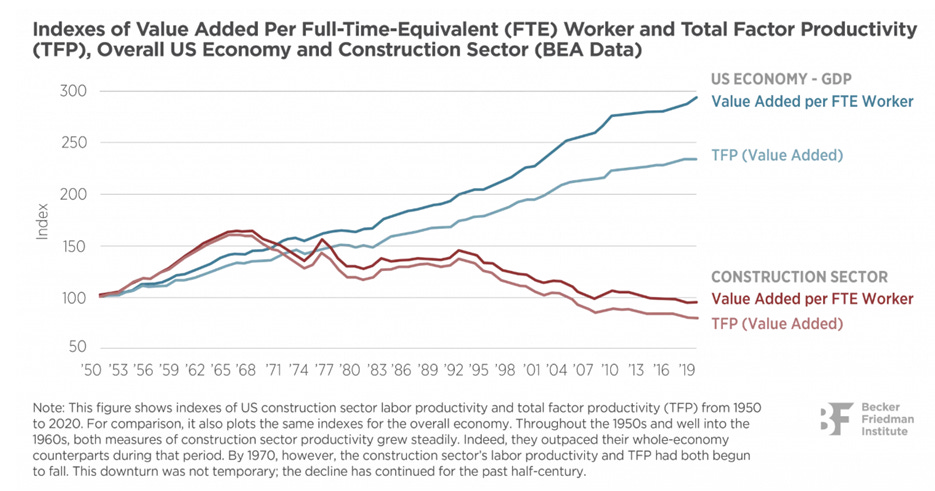
The key to affordability, most especially for housing, is increased productivity. The delays and arbitrariness of government officials in approving new buildings are the most important reason construction has seen sharp declines in productivity over the past 60 years. Since in no field is “time is money” truer than in construction, where high interest loans and long-lead times of labor and material allow costs to pyramid quickly, reducing approval times would make a substantial impact on affordability. One study from Austin Texas found shortening the time frame to approve multifamily housing by 3.5 months could reduce rents by 4 to 5 percent.
Some states, such as Texas and Florida, have already shown that third-party permitting can work. But these and other states can be bolder. States can allow more companies to provide more types of reviews, and they can allow those companies to operate without waiting for any government timelines. Bringing in private inspection and permitting companies on the technological frontier would remove one of the biggest sources of arbitrariness and corruption in government. It would also be the best way for states to improve housing affordability. If states want a more prosperous future, they should make government a facilitator of building instead of an opponent of it.
Permits are Power. Cities ain’t giving up any Power.
Thank you for posting this. Construction does not only have a technology problem, it has a scale, structure, incentive, and cultural problem. Permitting is one issue, and yes, tech can help.
Construction labor productivity has fallen more than 30% since 1970, the only major sector that has done this. Economists have called this "strange and awful." There's lot of room to modernize and get costs down. I write about this space at @levelsetbrief and the post on construction productivity is at https://levelsetbrief.substack.com/p/why-construction-productivity-has?r=1puo2m&utm_campaign=post-expanded-share&utm_medium=post%20viewer